

01Form
Sphere Fountains
How does a sphere shape the flow and appearance of water?
Follow water from the outlet across a curved surface, and discover how a sphere creates its distinctive fountain effect.
Explore fountains and water features through the shape of the water, their design language and the setting in which you experience them.
Find your starting point in nine in-depth guides to garden fountains and indoor water features. Explore by water flow, design or setting. Stone, metal and surface finish run through them all.
Finding your way
Each guide explores a distinct subject. Form, style and setting offer three ways to find it. A modern sphere fountain on a patio belongs to several perspectives at once: the guides connect, without one becoming a subcategory of another.
These five guides begin with water in motion: where it emerges, how it falls or flows, and the surface, edge or shape that defines it. Explore whichever principle interests you first.
How does a sphere shape the flow and appearance of water?
Follow water from the outlet across a curved surface, and discover how a sphere creates its distinctive fountain effect.

How do wall, spout and basin form a complete wall fountain?
Explore fountains built around a wall, where the back panel, projecting spout and receiving basin form one composition.

What happens when flowing water becomes a vertical surface?
A water wall carries a film of water down a surface. Explore how its height, width and texture change the space around it.

How do spillways, drop height and tiers shape a waterfall?
Follow water over a spillway or through a series of tiers, and discover how each drop shapes its appearance and rhythm.
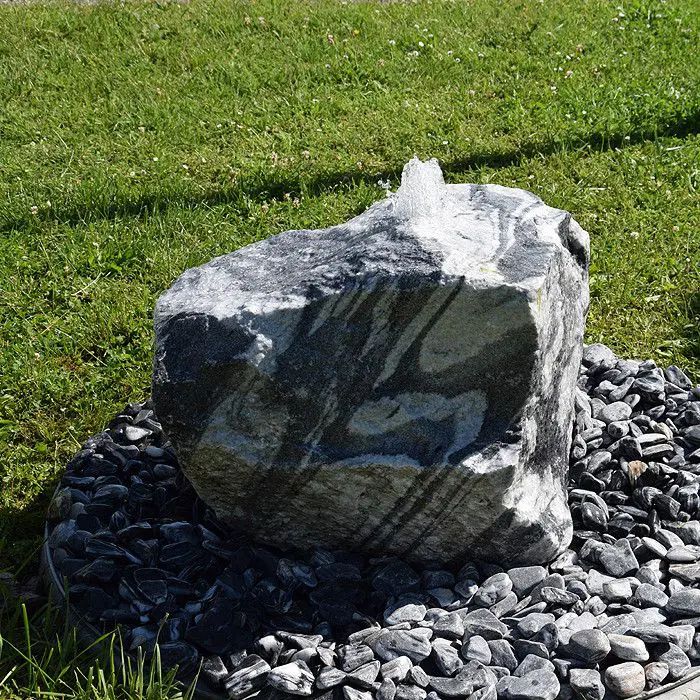
How does water bubble from a stone and flow back over its surface?
A natural stone becomes the fountain itself, with water emerging at the top and flowing over the rock.
The effect resembles a spring; a pump recirculates the water in a closed system.
Stone, metal and surface finish shape a water feature’s appearance and the way water flows over it. They run through all nine subjects, so material connects the guides rather than forming a separate category.
Veining, cutting and finishing give natural stone its character, from an unworked boulder to a carefully shaped fountain body.

Corten steel, stainless steel and other metals introduce crisp edges, reflections and colour, changing how a fountain catches the light and its surroundings.
Rough, honed, polished or mirror finished: the surface helps define the water’s appearance and the feature’s presence in a space.
Style connects a water feature to its architecture. Modern and classical designs offer different starting points, while allowing room for shared ideas. A wall fountain or a sphere can take either approach.

How can a water feature complement contemporary architecture?

How do classical garden fountains give a place its character?
The right style often begins with the house and its surroundings. These guides help you recognise the design language that fits your setting.
Scale, viewing distance, sightlines and access all matter. Explore what changes when a fountain sits outdoors on a patio or becomes part of an interior.

How the guides connect
The aim is to connect advice and product pages with the in-depth guide most relevant to each question.
Focused advice to help with a specific choice or practical question.
Explores a water feature’s form, style or setting and the details that matter.
A product page presents an individual fountain or water feature and its characteristics.
An example journey
Guide index
Explore by form, style or setting, or go straight to the guide that answers your question.
Back to the top